Sunday, February 28, 2010

Response to Katherine's "Texting"

Who is to say that texting is or IMing is a lower form of communication then talking on the phone or meeting in person?
It's true that texting while talking to someone is rude, but throughout history people have used written words as a way of expressing themselves in a more complete manner than through conversation.
Now, I'm not saying that texting hasn't devolved into a lesser form of communication. For example this is a quote from the Facebook of a friend of mine, I apologize for this atrocity.
i thik last night was deacent def had fun


But, communicating through text is not inherently a lower form of communication. In fact I'd dare to say that it is a necessary part of communication when used sparingly with face-to-face communication and telephone calls. These aren't levels of communication so much as they are equal categories.

Like all forms of communication there are levels of articulation to it. For example, speech is great, but there are things like this.

Question Time: Do you believe that speech in the two examples I gave is the creation of a new dialect (cyberdialect?) or simply the degradation of language?

So we put it on the fridge...

I've been mulling over the question of child-made art for a little while. First of all, is it even art? A child has the intention to create(the crayon drawing of the choo-choo was no accident) so that would make it art under most definitions. But the philosophers we have studied all have a second condition for what makes something art. I'm going to attempt to shorten the definitions if possible.
Plato: Art requires intention but is also an imitation of an imitation of a form. This one is pretty simple. Children often create pictures of what they see in the world.
Tolstoy: Art must intentionally convey an emotion. Children create art all the time that expresses how they are feeling. A picture of a rainstorm? The child is most likely sad. Children expressing their feelings through art is so common that it has become a regular practice with child psychology. Speaking of which...
Freud: Art is the expression of a desire. Art can express a multitude of desires for children. The desire for their parents to give them attention, the desire to express an emotion, or a desire to attempt to interpret the world their own way.

So here the question, can anyone come up with an argument to say that young children do not create art?

Saturday, February 20, 2010

Response to Tyler's "Art's Malleability"

I think that if we are only considering whether or not something is art then you're correct. If the artist intends for art to convey an emotion then he has successfully created art. However if the emotion is not received then there is noise in the communication process. Noise is anything that interferes with the communication of an idea, emotion etc. Now, this noise can appear in one of two places, either on the receiver(observer)'s end or the transmitter(artist)'s end. If we determine that it is the artist's fault (or that the noise is on the transmitter's end) then it is a comment on the quality of the piece of art. For instance if the artist wanted people to be made happy by his video of a rabbit rotting and everyone feels sorrow then the piece of art is communicating poorly and is an unsuccessful piece of art. But if an artist creates, using Tyler's example, a picture of a dog that is intended to make people happy but one person is made sad by it because it reminds him of his dead dog then it is noise on the side of the receiver. It is not low-quality art. There is a problem with the viewer. Actually this is pretty similar to my post on offensive art.

Is it truly possible to determine the quality of art if the artist's intended emotion is unclear to everyone?

Response to Aurora's "Tolstoy and Porn?"

I'm glad you brought this up. If we consider Tolstoy's history we see that he followed the word of Christ literally. From this we can gather that when he spoke of lust he wasn't referring to a general self gratification, but specifically carnal lust.
So for the sake of argument we will stick with carnal lust. I believe that it is possible for something to be both beautiful and carnally desirable. The distinction between pornography and art comes from intention. If something has the primary purpose of awakening lust then it is pornography.
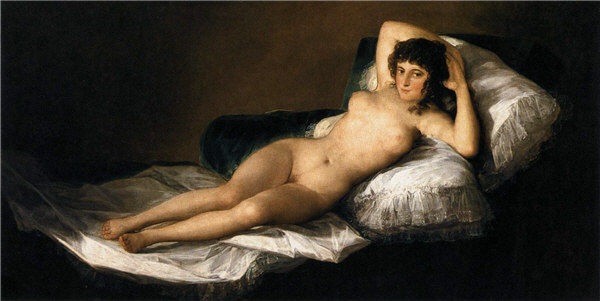
However, it is possible for something to find beauty in human sexuality. This is what we can term Erotica. Art depicting human sexuality in a beautiful manner. While it may not be the intent of the artist to cause arousal it is possible for arousal to occur when viewing even a beautiful representation of human sexuality. Here we see La maja desnuda (The nude maja) by 18th century painter Francisco de Goya. This painting is an example of erotica, we see the female form in a sexualized yet beautiful position.
Yes this picture contains what might be seen as explicit nudity.

La Maja Desnuda

So my question is do you think that it is possible for something to be both pornographic and erotic(erotic meaning beauty from human sexuality)?

Saturday, February 13, 2010

Response to Nicole's "Canibalism"

It would be very unwise to dismiss another culture's customs on the basis of morals. But it is unfair to say that our system of morals is "too rigid." Cultures, even cultures with common histories (American/British/Australian), have huge differences in morals. Americans for instance are deeply bothered by human sexuality, but less bothered by mediated displays of violence. The opposite is true in Britain.
Maybe each culture's system of morals is "too rigid," too unwilling to accept the moral differences in neighboring cultures.

What is the appropriate action when two cultures' morals clash on fundamental principles?

Response to Katherine's "Offensive Art"

I believe that they aren't so much more important than one another as they are different. It requires the intention of the creator for something to be considered art. However the quality of the art is judged by the audience.
If an artist produces a song it is most certainly art. It meets all of the basic qualifications of art. It is intended to be art and it is a creation. But if nobody likes the song it is considered a bad song. It's still art, but it has been deemed bad art. But that's only if the question involves the quality of art. If the question is, "What is more important to the decision of something being art the intention or the reception?" then I'd say the intention is not only more important but completely integral, the reception is irrelevant.

Thursday, February 4, 2010

Response to Misty's "Can There Be Too Much Knowledge?"

I'd like to begin by saying that I disagree with the assertion that humans have a finite capacity for knowledge. Never have I encountered a time when a human has honestly said, "I have reached the limit, I can learn no more." The only time a human stops learning is when he dies.
Equally disturbing is the assertion that a human should ever stop trying to learn about something. We can never know exactly what a poet or author meant by their works. So we continue to study, to attempt to learn to come closer to true understanding.
As for string theory? I find it too extreme to assume that everything in existence has invisible strings connecting each other.

"The theory depends for its existence upon magical coincidences, miraculous cancellations
and relations among seemingly unrelated (and possibly undiscovered) fields of mathematics." -Paul Ginsparg and Sheldon Glashow
Physics Today, May 1986

A more reasonable theory, especially when it pertains to literature is the idea of Degrees of Separation. That you can connect anything to anything else logically, but not physically.

Monday, February 1, 2010

What is Natural?

In class we came across the problem of Nature not being art. The way I see it Nature is anything that occurs in the world without the influence of Man. Yes, I understand that Man is part of nature therefore shouldn't everything he creates also be a part of Nature? I'm going to say no because of the need to draw a line. Otherwise everything in creation is natural and there will never be a distinction between the works of Man and the works of Nature.
Some of the things that Man has made are grand testaments to our skill and determination and never in nature will there be a Statue of Liberty or a Sistine Chapel. And credit must be given where credit is due.
Additionally, Nature has created works that Man cannot hope to recreate in the same splendor.
So instead of having to make Nature and Art categories of each other, I believe that it makes sense to make them aesthetic peers.

Question: If Nature and Art are aesthetic peers, are there any other categories that need to be amongst them?